Dates for 2026: Saturday 25.07.2026 – Saturday 01.08.2026.
Inti week is unfortunately sold out and has a very long waiting list. Registration is closed for 2026.
INTERNATIONAL WEEK 2026
What is International week?
International week takes place from 25. July – 1. August 2026. During International week, activities and day-to-day life are shaped by the people who partake in the week. We believe in community, sharing lived experiences and solidarity. We are proudly queer and feminist. International week stands apart from the other weeks of Femø Kvindelejren (Femø women’s camp), as it is an English-speaking week. See the “Inti 101”-section for more information.
Registration
Registration for International week opens on the 8th of March 2026.
In order to register, please use the following link: Registration Form
It is advised to sign up on the 8th of March, as the camp and weeks generally fill up fast.
What does International week stand for?
International week is a space where we share our lived experiences, take care of each other, and strive to grow collective awareness and strength. International strives to be an intersectional feminist space.
International week is open to all women, non-binary, and trans people, who are against the patriarchy. Cis-men are not welcome on International week.
The camp has its roots in the Danish feminist movement, with the first camp taking place in 1971 and has historically been cis-woman centered. You can read more about the camp and its activism on the website. Over time, the camp’s gender policy has changed, reflecting the on-going feminist discussions and a commitment to greater inclusivity. Today, International week leans towards a more open and expansive understanding of gender, welcoming diverse gender identities and attempting to dismantle patriarchal structures together.
We find that International week’s spirit can best be summarized by the following poem by Micky ScottBey Jones:
AN INVITATION TO A BRAVE SPACE
Together we will create brave space
Because there is no such thing as a “safe space” —
We exist in the real world
We all carry scars and we have all caused wounds.
In this space
We seek to turn down the volume of the outside world.
We amplify voices that fight to be heard elsewhere,
We call each other to more truth and love
We have the right to start somewhere and continue to grow.
We have the responsibility to examine what we think we know.
We will not be perfect.
It will not always be what we wish it to be
But
It will be our brave space together
And
We will work on it side by side.
Inti 101: Questions and answers
What do we do during International week?
Throughout the week, workshops organized by the participants of the camps will be held for everyone to join. It is, of course, entirely up to you, if you want to participate. Some workshops are planned beforehand, like the ones you can read about below. Others pop up spontaneously, when people want to share something with the group.
A workshop you will see is the classic Femø talking group: a conversation about a chosen topic where each participant shares their personal experience while everyone else listens without interrupting, questioning or commenting on the person talking. Historically, this has been a powerful space for people on Femø to hear their own experiences be reflected in others and feel a greater sense of community.
Halfway through the week we will have a big party, which usually includes dress-up (if you like). The party theme this year is the Enchanted Forest.
Besides the party and workshops, we enjoy the simple things like swimming in the ocean, lounging in the sun, singing, going on bike rides around the island and much more.
Who organizes the camp?
Femø Kvindelejren is an association and is organized with different functional groups, where (only!) volunteers take care of the multiple tasks in connection with the camp. The camp is divided into eight weeks and every week has its own week team that takes care of the planning and the organization of that specific week. Participants contribute to camp by sharing various tasks such as cooking, dishwashing, cleaning, and other practical duties. You will probably have one duty a day, where you help keep the camp running smoothly. Duty sign-up takes place twice during the week so that you can combine camp duties with your workshop interests and other activities – or hanging out.
What should I expect and what should I bring to International Week?
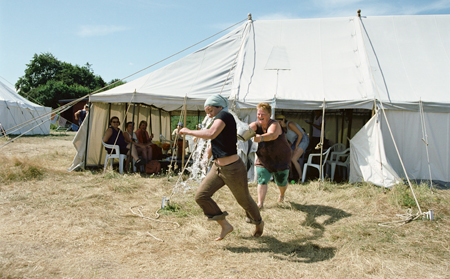
The camp is located on a beautiful meadow close to the seaside. The camp itself consists of large common tents and an area for small private tents. As for amenities, we have fresh drinking water, a well-equipped kitchen tent with gas stoves, and basic facilities, including a warm shower and simple toilets.
The large common tents are where we cook, sleep and relax, but a lot of the time on camp is spent outdoors. When planning and preparing for international week, it is important to bring clothes that are suitable for the Danish summer (notoriously a mix of rain and sunshine). Once you have registered, you will receive a welcome letter with more information, including a packing list for inspiration.
Most people choose to sleep in the large common sleeping tents. It is possible to bring your own tent. Only small tents are allowed. Check out International week’s website for more information regarding the camp and how to get to the camp. The easiest (and nicest) way to get to the camp is by a chartered bus from Copenhagen or Rødby ferry harbor.
What should I be mindful of?
International week strives to build a queer and feminist international community across borders and cultures, which doesn’t have a common language. At the core, International week celebrates language, community and togetherness. International week and After-camp are the only two weeks of Femø where the common language is English. Nobody is expected to speak perfect English, but we encourage everyone to speak English in the common areas, so that everybody may feel included.
On International week, we try our best to make everyone feel seen and heard. Each and every one of us has a responsibility to listen and to try and understand each other’s points of views – whether you are a feminist in your seventies or a genderqueer person in your twenties. At camp, we introduce ourselves with names and pronouns. This allows us to get to know each other. You do not have to share your pronouns, if you don’t want to, but please respect all pronouns, even if they sound unfamiliar to you.
Children
Typically, we have a small group of children at International week. We arrange daily activities for a couple of hours where the children and designated children’s activists at camp come together.
During the common meetings in the evenings where we share important information, the agreement is that children are to be in the background or have been put to bed (bring a baby monitor for these situations). It is often helpful to ask another adult in the camp before the meeting to support you as a parent and relay information if you cannot attend the meeting, or help with practicalities. Many adults or young people are glad to assist and connect with your children, but they need to know what you need, in order to be there for you and your kids.
WORKSHOPS PROGRAM 2026
Be mindful that the description of the workshops are subject to change.
Introduction to Clowning
An invitation to a joyful, whimsical, and dreamlike journey through a clown experimentation workshop. Through a variety of games and improvisations, we will explore connection, contrast, spontaneity, and playfulness. Through play, the clown raises fundamental questions about each person’s place within the group and within the universe. And through their quirky way of responding, they offer a fresh, curious, and poetic perspective on our challenges, gently defusing the drama of existence.
Bicycle Care and Confidence
This workshop is for anyone who loves their bike, but doesn’t know how to show it. We will work on the Femø bikes and talk about bike anatomy, how to spot some common problems, and then get our hands dirty and practice changing tubes and tires, adjusting cables and brake pads, and tension chains. By the end of the workshop, the Femø bikes should be happy and ready to roll and hopefully everyone will feel more equipped to take care of their own bike and more confident when bringing their bike to a mechanic.
Soft and Strong: an hour of gentle yoga and self massage
Join us for a gentle yoga workshop designed to help you connect with your body and nervous system in a space of trust, recovery, and empowerment. In this workshop, we use mindful movement and somatic awareness to soften into your body, regulate your nervous system, and deepen a sense of trust and confidence in yourself. The workshop’s approach is rooted in empowering you to connect with your body’s innate wisdom and cultivating resilience.
Remember to bring a yoga mat or blanket to use during the session.
Introduction to Shibari
This hands-on workshop explores the art of Shibari, focusing on its creative, connection, mindful and possibly erotic practices. In the first 1.5-hour session, participants will learn about fundamentals of communication, consent, and safety in rope play. Afterwards we will show foundational techniques, including the single column tie and useful twists, to build patterns. No prior experience is needed, and all materials will be provided. We would ask participants to sign up beforehand (on camp), since we can only offer the workshop for a maximum of 10 persons. Sign up can be paired but does not need to be, if there is openness to connect with others. Please note that this workshop will include some form of physical touch and closeness.
In the second 1.5-hours session we would like to offer an open rope space for participants of the first workshop or others who already come with experience. We will provide (some) ropes and music and will be present for questions or advice. But mostly there should be space for practice and connection between the participants.
The Art of Asking Questions
A practical workshop on how to look at people and situations with an anthropological lens. We will explore how to stay curious, how to listen without judgment, and how to ask questions that open rather than close. Together we will learn what makes a good question, what makes a question limiting, and how to create space for someone else’s world to appear. The workshop includes short explanations, live demonstrations, and paired exercises where participants practice observing, listening and asking.
Inspirational lecture and discussion: Our forgotten history
Based on historical research on lesbians, queers, non-binary, and transmasc and their love lives, this lecture tells the fascinating – and forgotten – story of individuals, who broke norms and expectations for gender, love and family making in the late nineteenth century.
Differently from male same-sex activities, female same-sex engagements were not criminalised in countries like Britain, Germany and Denmark – and this opened for visible and vibrant queer communities. The lecture provides us with the history we did not know we had; a history of love, sex, community, openness and joy.
The lecture will be followed by discussion, where we can share our own stories and connect with the past. Through the history and our talk, we might collectively create new imaginaries and utopias for women*, queers, lesbians, and transpeople
Whittling
Whittling is the art of carving shapes out of wood using a knife, an age-old practice that transforms fresh wood into beautiful objects or funny shapes. This workshop is for beginners or experienced woodlovers, offering a step-by-step guide to the basics of knife handling, wood selection, and carving techniques. As we shape the wood shavings together, you will also experience the meditative and gratifying process of creating with your hands. It is a chance to slow down, and maybe even create something personal to take home. In camp we have whittling knives, so you don’t have to bring your own, unless you have a special connection to your own tool.
Introduction to Whacking
This workshop will explore the history of whacking and the basic movements itself. Whacking is a historically queer dance style that originates from the queer bipoc communities of the disco scene in Los Angeles in the 70s. It is queer heritage, and in teaching this dance style we preserve the important history of queer dance and where it really comes from and why it is so important. The workshop will include a history lesson to honor and respect its origin in queer black and brown spaces. Whacking is still danced in both ballroom spaces and has become more global in the sense of whacking dance competitions. It is a dance style that deeply explores your inner feelings and a release to feel freedom and authentic queerness.
Embroidery
In this workshop we will learn different types of stitches that you can use to create exactly what you dream of. Embroidery can be done on anything: underwear, pants, sweaters, dish towels — you name it. Bring your favorite clothing items and give them new life with embroidery. We can both add words and create drawings. Got clothes with holes in them? Bring them along and we’ll patch them up with some embroidery.We can also play with different dimensions by adding beads and other pieces of fabric. Feel free to bring old fabric scraps, beads or other fun things from home to add in your project.
In addition to your own projects, we will also create a shared piece. The theme will be: “I protect my right to” — and you can add exactly what it is you protect your right to. It can be political, playful, or feminist expressions.
Please bring embroidery needles and embroidery thread. These can be purchased at thrift stores or craft shops. Some find it helpful with an embroidery-ring (helps keep the fabric stiff and still while working on it). It can be a good idea to bring one of these as well.
If you have any questions, please contact trinefrost94@gmail.com.
Combined talking group: Living and loving with psychological vulnerabilities
Participants will be introduced to a form of guided gentle breathwork based on resilience informed/ and trauma recovery methods. The exercises stimulate the vagus nerve, which helps regulation of the nervous system. They take about 20 minutes. The rest of the time will be a Femø-style talking group around recovery and mental health, exploring ways we can and do support our own mental health in daily life and in our relationships.
Talking group: Menopause
Whether you’re approaching menopause and curious about what to expect, currently navigating it, or already through it, or if you are not able to experience it but wondering what it is, or have other experiences with hormonal change – this is a space for open, honest conversation. We’ll share experiences about how menopause affects our daily lives – physically, emotionally, and practically. Together we’ll explore different approaches to managing symptoms, from medical treatments to lifestyle adjustments and everything in between. No question is too small, no experience too personal. This is about learning from each other, finding solidarity, and discovering what works for different people in different situations. Come as you are – listener, sharer, or somewhere in between. All perspectives are welcome.
Talking group: Femø Memories and Footprints
This talking group centers on how Femø has impacted our lives and sense of community. It will be an open space for sharing personal experiences and stories and for any kind of personal reflections and thoughts. Some may have found (or lost) a love on Femø. Some people may experience a togetherness and belonging on Femø they do not have access to in their everyday life. Some have seen their kids grow up here. Others may have found good friends. Some people enjoy catching a glimpse of Danish culture and language. And for some the camp is an important source for political ideas or for personal growth.
No matter how long and how little time you have spent on Femø, this is a space to honor those unique feelings and experiences. Even if you are a Femø-newcomer, you are welcome to share your first impressions and/or what made you join the camp. Femø can be an overwhelming experience, but does not have to be expired alone.
OTHER ACTIVITIES
Fire and storm
Fire and storm is a safety instruction regarding what to do in the case of bad weather, fire or other emergencies on camp. This activity is mandatory for every camp participant, no matter if you have been to Femø before or it is your first time.
Games and playtime
Each day of the week, we want to have an hour of organized fun activities, like board games or active games. You are invited to share your interest with everyone attending the camp in a relaxed setting. On the evening before, we find out who is going to present or facilitate the playtime for the next day. If nothing particular is suggested, playtime can still be used as a way to meet up and relax, read together or play a game.
Pop-up workshops
In addition to the workshops that are planned, participants are welcome to organize pop-up workshops throughout the week – like a joint tour to the other side of the island in our kayaks, queer astrology, stretching before breakfast and so forth.. And who knows – we might continue a 50-year-old tradition and make beautiful art pieces with our own private parts.
CONTACT
For more information about payment and transport, please check out International Week’s website here. For questions related to the camp and week, please contact Caro and Sophia using intiweek@gmail.com.